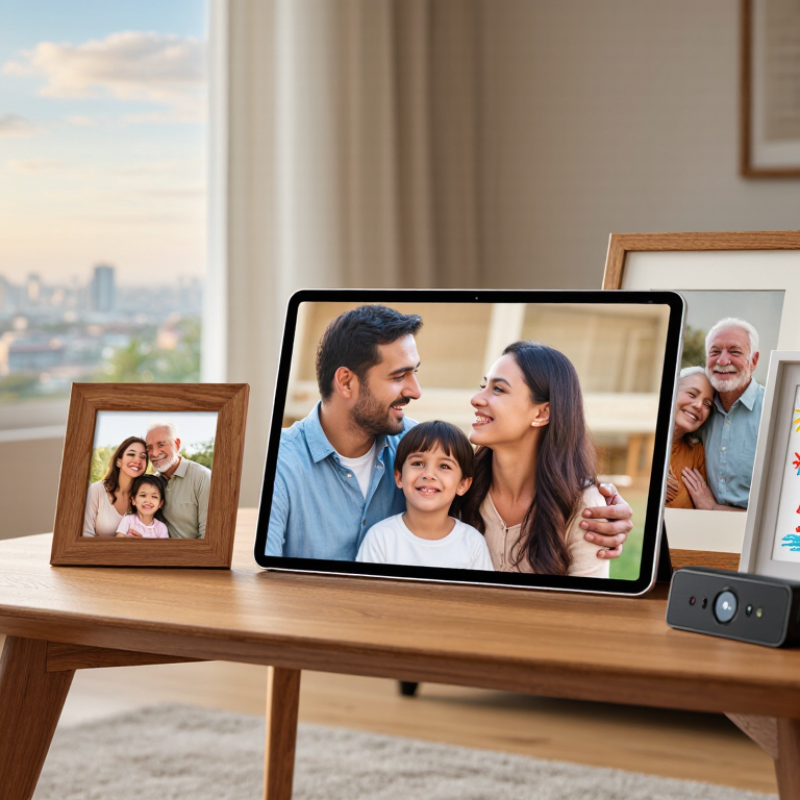
Choosing the right Photo Frame Gift in 2026 means balancing emotion, technology, and practical daily use. A frame may display a wedding photograph in London, a child’s drawing in Toronto, or family memories across different time zones. The best choice should feel personal before it feels expensive. It should also work reliably.
Abdur Chowdhury, co-founder of Aura Frames, has expressed the central design goal this way: “The best frame is the one that keeps memories present without demanding attention.” That idea matters for global buyers. Clear screens, simple sharing, strong privacy controls, and easy setup can turn a device into a meaningful household object. Buyers should also check language support, plug compatibility, delivery conditions, and regional app availability. Small details often decide whether a gift delights or disappoints.
This guide explores the 2026 Photo Frame Gift market through real buying situations. It compares smart frames, traditional frames, portable displays, and personalized options. Some choices suit grandparents who prefer fewer buttons. Others fit travelers, newly married couples, or families separated by oceans. A premium frame is not always the best answer. Sometimes, a lightweight printed frame feels warmer and lasts longer.
There is no perfect gift.
Even accurate recommendations have limits. Family habits change, software support may end, and beautiful screens can still create unnecessary waste. Our suggestions therefore consider experience, product usefulness, design quality, privacy, and long-term value. The goal is simple: help global buyers choose a frame that continues to matter after the wrapping paper disappears.
For global buyers, a digital photo frame can turn a kitchen shelf into a changing family gallery. Grand View Research’s Digital Photo Frame Market report projects a compound annual growth rate of about 3.4% from 2023 to 2030. This moderate pace suggests steady demand, not a short-lived gift trend. Buyers should examine screen brightness, cloud access, storage limits, and plug compatibility before choosing a model.
Mordor Intelligence also identifies connected home devices and online retail as important market drivers. These findings support gift designs that are simple to install across regions.
A 10-inch screen, clear setup guide, and multiple language options can reduce return requests. Wi-Fi stability matters. A beautiful frame is frustrating when photos load slowly.
Consumer expectations still vary by country. Some families prefer private local storage, while others enjoy shared albums. Energy use and data protection deserve more attention than they often receive. Grand View Research’s forecast is useful, but market definitions differ between research firms. That makes exact growth figures imperfect. Gift sellers should treat the CAGR as a direction, not a guarantee, and test preferences in each target market.
2026 Best Photo Frame Gift Ideas for Global Buyers?
Statista’s global e-commerce and gift-shopping data shows continued opportunities for practical, emotional presents. Photo frames fit both needs. They preserve family memories while remaining easy to understand across cultures. Global buyers often compare price, delivery time, reviews, and product usefulness before ordering. A frame with simple controls may perform better than one with excessive features. Digital models suit remote families, while wooden frames appeal to buyers seeking a warm, physical gift. Size matters too. A compact frame fits office desks and small apartments. A larger frame creates stronger visual impact in family rooms.
Buyer demand is not identical across markets. Statista figures should be checked by country, year, and product category before making inventory decisions. Gift purchases often rise around local holidays, weddings, birthdays, and family celebrations. However, seasonal patterns can change quickly. I would avoid relying on one global average. That assumption sounds efficient, but it can mislead purchasing plans. Packaging, clear instructions, regional power compatibility, and dependable customer support can influence trust as much as appearance. Privacy settings also deserve careful attention, especially for connected frames displaying personal photographs.
Tips: Offer several price levels and frame sizes. Show realistic room photos, not only studio images. Explain setup steps in plain English. Mention delivery estimates clearly. Review customer complaints monthly. They reveal practical problems that sales charts may miss. Check the newest Statista data before each major buying season.
For 2026 gift buyers, the frame type matters more than decorative styling. Analog frames remain inexpensive, tactile, and easy to personalize. They suit printed family portraits, travel photos, and homes with weak internet access. Their limitation is obvious: changing images requires printing and handling paper. Grand View Research reports continued growth in the global digital photo frame market, reflecting demand for convenient visual displays.
Digital frames store images locally and usually offer sharper screens, adjustable brightness, and slideshow functions. Wi-Fi models add remote uploads, which helps families living across different countries. Omdia’s smart-home research shows connected devices are moving toward everyday household use, but connection quality still varies by region. A buyer should check voltage, language support, cloud fees, and offline playback before purchasing. Small details matter.
AI photo frames can organize albums, improve portraits, recognize scenes, or create themed displays. Mordor Intelligence identifies artificial intelligence as an important direction in connected consumer electronics, although photo-frame-specific adoption remains difficult to measure. The technology feels impressive. It also needs restraint. Facial recognition can misclassify people, while automatic enhancement may make skin and memories look unnatural. I would choose models with clear deletion controls, local processing options, and visible consent settings. No feature is perfect. A simple digital frame may still create the warmer gift experience.
Choosing a photo frame gift for global buyers requires more than attractive images and a bright display. Compliance should shape the product from the first design sketch. In the European Union, a frame may need CE marking for applicable safety, electromagnetic compatibility, and radio requirements. RoHS controls restricted substances in electrical components. WEEE obligations address collection, recycling, and producer registration. Requirements can differ between countries.
The United States focuses heavily on FCC rules for digital devices and wireless functions. A connected frame may need testing for unintentional or intentional radio emissions. FCC compliance does not replace electrical safety or recycling duties. Keep test reports, declarations, user manuals, and labeling records together. A printed WEEE symbol, accurate importer details, and correct power-adapter information can prevent avoidable delays.
Small details matter. Check voltage ratings before selecting a gift model. Confirm that the adapter matches the destination market. Review packaging language and disposal instructions. Battery-powered versions may create extra transport and recycling questions. I would not rely on a supplier’s “global certification” claim without seeing current documents. That shortcut sounds efficient, but it can fail during customs review or marketplace checks. Regulations also change, so a 2026 launch should include a fresh legal review and product retesting when components change. A beautiful frame is useful only when it arrives safely, works reliably, and can be handled responsibly after use.
| Target Market | Recommended Gift Product Positioning | Main Market-Access Requirements | Wireless / Radio Requirements | Hazardous-Substance Requirements | E-Waste / Producer Responsibility | Labeling and Documentation Notes |
|---|---|---|---|---|---|---|
| European Union and EEA EU Member States, Iceland, Liechtenstein and Norway |
Wi-Fi photo frames, family-memory gifts, calendar displays and models with cloud or mobile-app functions. | CE marking is generally required for covered electrical and electronic products. Typical legislation may include the Radio Equipment Directive for wireless models, the Low Voltage Directive where applicable, and the EMC Directive where applicable. | Wireless models generally require conformity with the Radio Equipment Directive, including radio, electromagnetic compatibility and applicable safety requirements. | EU RoHS restricts specified hazardous substances in electrical and electronic equipment, subject to product scope and exemptions. | WEEE obligations generally apply, including crossed-out wheeled-bin marking, producer registration or reporting, and financing or organizing collection according to each country’s rules. | Prepare an EU Declaration of Conformity, technical documentation, risk assessment, test reports and user instructions. CE is a conformity mark, not a quality award. |
| United Kingdom Great Britain and Northern Ireland |
Premium personalized frames, smart-display gifts and models designed for connected households. | Great Britain uses UK product regulations and may accept UKCA or, for certain products and transition arrangements, CE marking. Northern Ireland rules can require CE, or CE plus UKNI, depending on the conformity-assessment route. | Wireless products must meet applicable UK radio-equipment requirements in Great Britain. Northern Ireland follows applicable EU radio-equipment rules under the Northern Ireland framework. | UK RoHS restricts specified hazardous substances in electrical and electronic equipment, subject to scope and exemptions. | UK WEEE producer obligations generally include registration, reporting, financing or arranging treatment, and the crossed-out wheeled-bin marking where applicable. | Use a UK Declaration of Conformity where required, retain technical files, appoint a responsible person or authorized representative when applicable, and verify current marking transition rules before shipment. |
| United States | Cloud-connected frames, app-enabled gifts, USB-C models and large-screen family display products. | There is no single general U.S. equivalent to CE for ordinary consumer electronics. Products must comply with applicable Federal Communications Commission rules, electrical safety expectations, consumer-product rules and state requirements. | Intentional radiators such as Wi-Fi or Bluetooth devices generally require FCC equipment authorization before marketing. Unintentional radiators are subject to applicable FCC authorization and labeling rules. | The United States has no single nationwide RoHS law covering all electronic products. California and some other jurisdictions may impose substance restrictions or disclosure obligations for specific products or materials. | There is no nationwide WEEE program equivalent to the EU system. Electronic-waste obligations may arise under state laws, retailer programs or local recycling requirements. | Keep FCC reports and supplier declarations. Check power-supply safety certification, battery-transport rules, privacy notices, children’s-product rules and state-specific environmental requirements. |
| Canada | Bilingual gift packaging, connected frames and products suitable for seasonal gifting. | Electronic products must meet applicable Canadian safety, electromagnetic compatibility, labeling and consumer-protection requirements. | Radio and wireless devices generally require Innovation, Science and Economic Development Canada certification and applicable Canadian labeling. | Canada does not have one nationwide RoHS regime equivalent to the EU. Certain provinces and product categories may have chemical, recycling or product-stewardship rules. | Electronic-product stewardship is mainly provincial or territorial. Requirements, registration, fees and accepted product categories vary by jurisdiction. | Provide required English and French consumer information where applicable. Confirm importer obligations, Canadian radio certification and provincial stewardship requirements. |
| Australia | Wi-Fi photo frames, compact travel models and gift bundles with compliant power adapters. | Electrical equipment may require compliance with applicable Australian communications, electrical-safety and supply laws. The RCM is used for products covered by the relevant regulatory arrangements. | Wireless and radiocommunications devices generally require compliance with Australian Communications and Media Authority requirements and registration in the applicable supplier system. | Australia does not operate a single nationwide RoHS law equivalent to EU RoHS for all photo frames. Substance requirements may apply through specific product, chemical or state rules. | Australia has product-specific and voluntary or regulated recycling schemes rather than one universal WEEE framework. Check applicable state and territory obligations. | Maintain a supplier declaration of conformity, test evidence and product records. Verify power-plug, adapter, labeling and importer requirements before sale. |
| New Zealand | Simple plug-and-play frames, connected family gifts and models with low-power standby modes. | Electrical products must comply with applicable New Zealand safety, electromagnetic compatibility and consumer-information requirements. | Wireless products must comply with applicable radio-spectrum and telecommunications requirements administered in New Zealand. | New Zealand does not have a general RoHS regime identical to EU RoHS for all photo frames; verify any product-specific chemical or environmental rules. | There is no single nationwide WEEE law equivalent to the EU system. Product stewardship requirements may apply to designated product categories. | Confirm electrical safety evidence, local plug and adapter compatibility, radio compliance and product-stewardship duties for the selected product category. |
| Japan | Minimalist digital frames, high-resolution displays and gifts with Japanese-language menus and instructions. | Electrical products may be subject to the Electrical Appliances and Materials Safety Act, depending on product classification and power-supply design. | Radio equipment must comply with Japan’s Radio Act. Wireless modules and host products require careful review of approval, labeling and installation conditions. | Japan has product-specific chemical-management requirements. J-MOSS marking is associated with specified electrical and electronic products and restricted substances; confirm whether the frame is in scope. | Japan does not use the EU WEEE system as a universal framework for all photo frames. Recycling duties depend on product category and applicable local rules. | Prepare Japanese instructions and labeling where required. Check power-voltage compatibility, wireless certification, PSE classification and importer responsibilities. |
| South Korea | Smart photo frames, family-sharing devices and models with Korean-language setup support. | Electrical and electronic products may require Korean safety conformity procedures, electromagnetic compatibility compliance and product-specific registration. | Wireless products generally require conformity assessment under Korean radio and telecommunications requirements. | Korea operates restrictions on hazardous substances and recycling-related requirements for covered electrical and electronic equipment; verify the current product category and scope. | Producer responsibility and recycling obligations may apply to covered electronic products. Registration, reporting and recycling fees can depend on the category. | Use Korean-language safety information where required and confirm certification, importer, labeling, battery and software or privacy obligations. |
| Singapore | Compact connected frames, apartment-friendly gifts and USB-powered products. | Controlled goods may require registration and safety approval under Singapore’s consumer-product safety framework. Requirements depend on the product and power-supply configuration. | Wireless equipment must comply with applicable Infocomm Media Development Authority technical and registration requirements. | Singapore does not apply a general EU-style RoHS regime to every photo frame, but chemical and environmental requirements may apply through specific regulations. | Singapore has an extended producer responsibility system for regulated electrical and electronic waste, with registration, reporting and financing obligations for covered products. | Verify controlled-goods status, local responsible-party duties, wireless registration, power-adapter safety and e-waste obligations before import. |
| United Arab Emirates and Gulf Region | Premium home gifts, large-display frames and models with multilingual interfaces. | Requirements vary by country. Products may need conformity registration, import documentation and local-market labeling through the relevant national authority. | Wi-Fi, Bluetooth and other radio functions may require type approval or telecommunications registration in the destination country. | RoHS requirements are not uniform across the region. Buyers may request EU RoHS evidence as a commercial condition even where local law differs. | WEEE rules are not uniform across Gulf markets. Confirm local waste, recycling, importer and municipal requirements. | Check voltage and plug type, Arabic or bilingual labeling, local representative requirements, radio approval and customs documentation for each country. |

Important Compliance Notes for 2026
For 2026 buyers, a photo frame should be selected through a practical gift matrix, not personal taste alone. Match screen size, storage, connectivity, budget, occasion, and region. Grand View Research’s 2024 Digital Photo Frame Market report identifies connected displays as a growing category, supported by easier wireless sharing and smart-home adoption. However, growth does not guarantee better gifting.
For family birthdays, a 7–10 inch frame with simple controls suits moderate budgets. Wedding gifts may justify higher resolution, automatic brightness, and stronger materials.
For corporate appreciation, reliability, multilingual menus, and secure photo transfer matter more than decorative features. The Consumer Technology Association reported that consumers increasingly value convenience and connected experiences in home electronics.
Still, some recipients dislike complicated setup. A beautiful gift can fail there.
Regional fit changes the matrix. North American buyers may prefer larger screens and cloud sharing. European shoppers often examine energy use, privacy settings, and plug compatibility. Japanese homes may favor compact frames with quiet operation. In Gulf markets, premium presentation and family-centered occasions can influence spending.
NRF reported continued high holiday expenditure in the United States, but price sensitivity remains uneven across households. Use local currency and realistic delivery costs. Do not assume “premium” means universally better.
I would also test the setup with older users before recommending it; that step is often missed. EU privacy requirements and local electrical standards should be checked before cross-border sales.